


An easy recipe and guidelines for making homemade raw dog food that you can tweak as necessary to what best fits your dog.
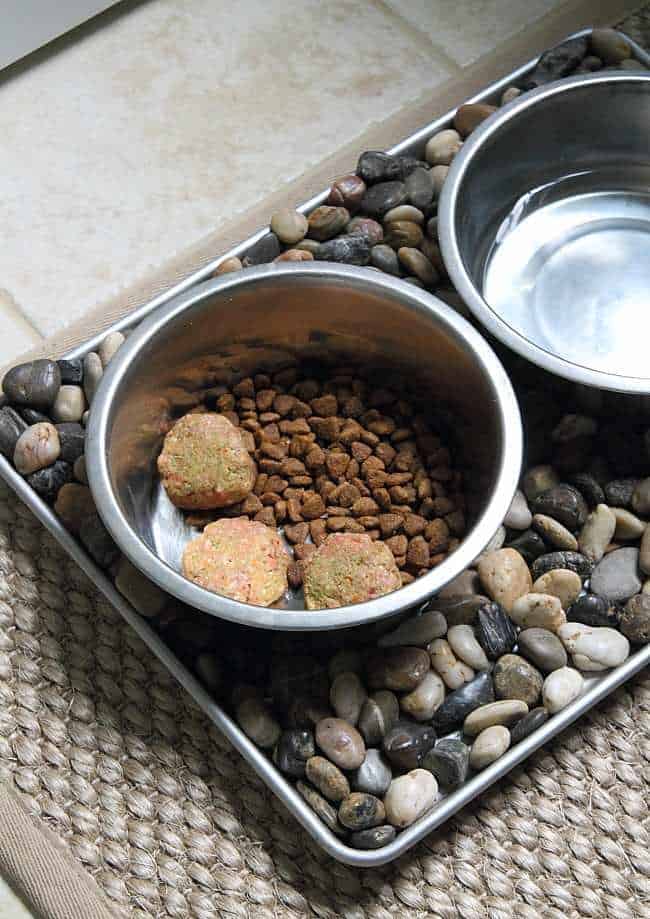
Save this recipe!
For as health conscious as I am about what kind of foods I put in my own body, I have to admit for the better part of six of her seven years, I pretty much fed Ginger the equivalent of fast food to humans.
Sure, it was the good fast food but after awhile, even Chick-Fil-A isn’t “healthy” any more if you know what I mean.
Of course, occasionally, I made her homemade pumpkin dog treats but more often than not her food was anything but homemade.
Then one day earlier this year it was like a switch got flipped.
The guy who sold us our water softener system was sitting in our kitchen and as we looked over models trying to figure out which one made the most sense, the sales guy and I started talking about dog food.
He explained how he starting feeding a raw food diet for his adult dogs and how their energy levels were through the roof (not that Ginger needs help in that department), their coats were shinier than ever and their teeth in great shape.
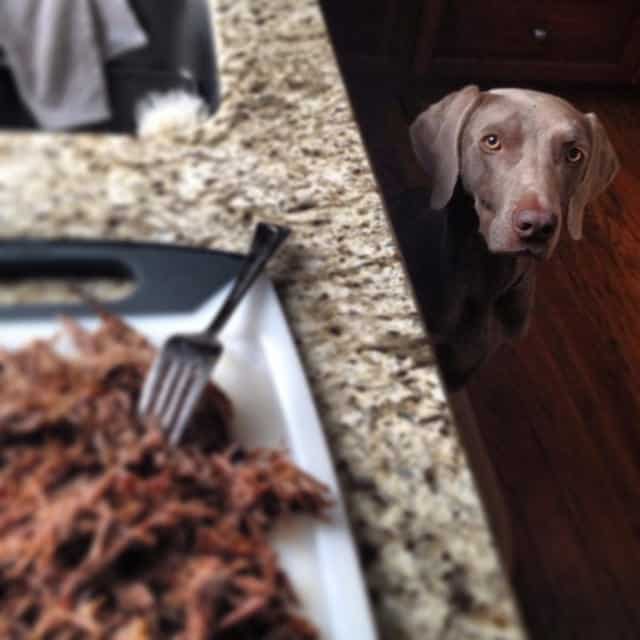
It made sense.
I completely buy into the same theories from a human perspective, why wouldn’t it be the same for dogs?
So, next trip to Petco, I was forking over some serious money (like 3 times the price of dry food) for frozen raw dog food patties and giving this whole thing a shot.
The first meal I gave her the homemade raw dog food, she came running back into the kitchen after licking the bowl clean as if she was begging for more.
As I was preparing the second meal and she saw me take the food out of the refrigerator, she just about lost it running back and forth between the kitchen and the laundry room (where we feed her), her legs moving faster than her body could on the wood floor running into chairs and walls like a lunatic.
It appeared she liked it.
At $25 for 3 pounds of food however, I knew immediately that wasn’t going to happen and I needed to start looking into some homemade dog food recipes.
Sorry, pup, I don’t eat out every day either.

So, I got to researching.
And it turns out, making your own raw dog food isn’t really that hard for dog owners.
It’s a bit disgusting as you see raw meat and organs swirl around in your food processor, but it’s not difficult by any means.
And yes, dogs can eat raw meat.
I think that’s the number one question I get when talk about this with people so I figured we’d get that out of the way first. Raw meals are not only a healthy choice for you dog, it’s what they were born to eat. Commercial dog food is something big industry made up in the middle of the last century along with the rise of human processed foods. Like in humans, this transition has lead to a slew of health issues for our pets and an obesity epidemic that matches that of their owners.
And if you’re wondering what else dogs can eat, check out my other site – What Can My Dog Eat?
Raw Dog Food Recipe Proportions (BARF diet)
The BARF diet stands for “biologically appropriate raw food diet”. Under this raw dog food diet, a dog’s diet should be high in protein, moderate in fat with a minimal amount of carbohydrates. When broken down into percentages, it will look something like this:
- 70% muscle meat with fat
- 10% raw edible bones (chicken feet can be great for this)
- 10% organs
- 5% fresh vegetables/fruits
- 5% dairy/supplements/nuts/seeds
Using those simple proportions, you can pretty much make up your own recipe from whatever you have on hand or find on sale at the store or.
Meat with fat: I will usually buy ground meat of some sort for this just because it’s easier than breaking down other cuts. Beef, chicken, pork, bison, gamey meats, etc. Muscle meat provides essential amino acids and vitamins for the dog. If your dog has any food allergies, it will likely be to a specific protein. Choose a protein type that works best for your dog based on their health conditions.
Bones: Raw edible bones are an important part of the BARF diet for essential nutrients like calcium and phosphorous.
Organs: The good news is organs are cheap. The bad news is organs are kind of gross. Nothing like some slimy chicken livers getting pulsed up in your food processor. Liver and kidneys are the two easiest to find in the grocery store. Liver is also the most nutrient dense organ there is providing fat-soluble vitamin A and other water-soluble vitamins.
Vegetables/fruits: Ginger happens to hate raw vegetables and fruit. She’s literally spit them out before or eaten around them if we’ve tried to feed her some in her bowl. So I choose sweet things here like apples, carrots and sweet potatoes that get processed real fine so she can’t tell. Avoid onions, grapes and raisins as they can cause kidney failure in dogs. It’s also a myth that vegetables provide no nutritional value to dogs. While they’re not necessary to support healthy dogs, they do provide added minerals and nutrients for better health overall.
Dairy/supplements: Whole eggs (shell and all) are a great source of calcium. I’ll also use some plain yogurt to help bind the patties. Supplement wise, ground flaxseed meal, olive oil and fish oil are great additions too. You can also choose to feed your dogs sardines for the healthy omega-3 benefits similar to olive oil.
How much raw food do I feed my dog?
This question has come up a lot in the comments so I figured I’d address it in the post.
The general guideline for adult dogs is to feed a balanced diet between 2-3% of their bodyweight. So, for a 50-pound dog that would be between 1 to 1.5 pounds of food per day.
Influencing factors on determining feed amount
- Activity Level
- Adjustments for weight gain or weight loss (the graphic in this post is helpful in that regard although discussing with your vet is probably best)
- Life Stage
Activity level
Be honest with this assessment. Is your individual dog mostly a lounger that hangs out inside all day with a few backyard jaunts or is it a truly active dog like a sporting breed that hunts, a working dog like a police K9 or your pal that goes hiking with you multiple times a week for hours on end?
Human tendency is to over emphasize/assess activity levels.
Adjustments for weight gain or weight loss
Simply put, does your dog need to lose weight? Gain weight? Maintain? The answer to those questions will help you figure out which end of that 2-3% spectrum you want to start with when starting a raw food diet.
Life stage
Notice I said adult dogs when referring to the 2-3% of body weight for food amounts. Puppies are an entirely different story as they’re quickly growing and need more calories to support that growth.
There are two approaches for feeding puppies:
- 2-3% of their expected adult weight (obviously easier to figure out with a pure bred dog)
- 5-6% of their current puppy weight – adjusting with the dog as it grows
Senior dogs shouldn’t have drastically different needs than a middle-aged dog unless of course, activity level impacts them.
Pregnant dogs are something you should speak to your vet or a veterinary nutritionist about in determining the best amount of raw food to support a healthy pregnancy.
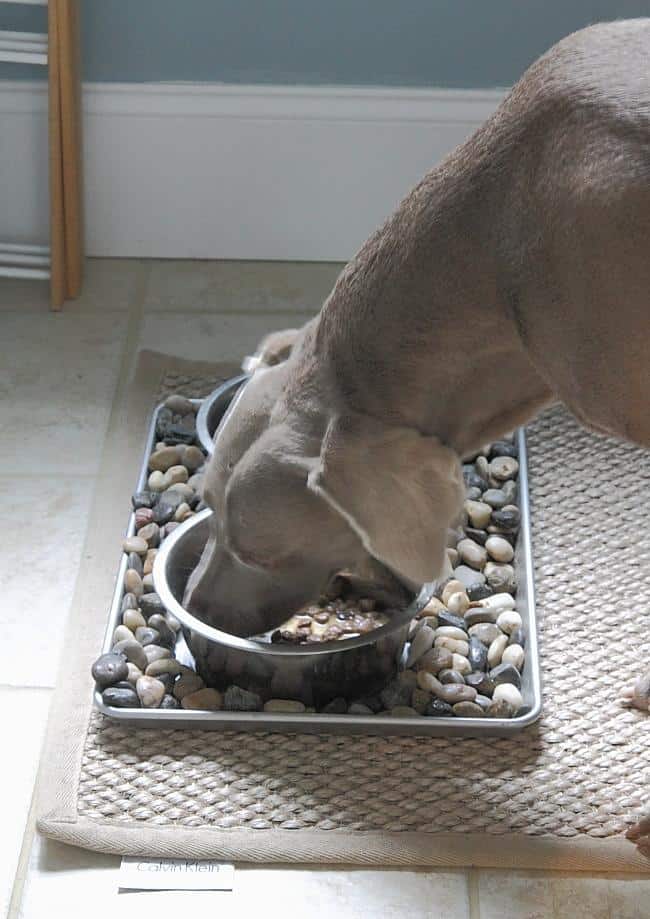
Making our dog homemade raw dog food has just become a part of the weekly routine now.
We do half of the homemade raw dog food recipe and half dry food which we upgraded as well to a grain-free feed with ingredients that make me comfortable when I read the back of the bag.
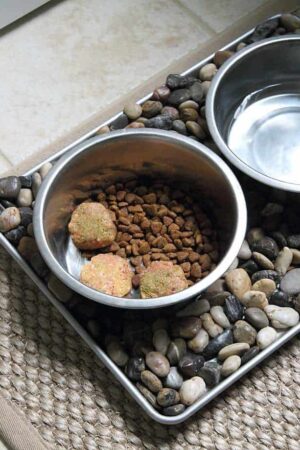
Because digestion rates of dry food (kibble) and raw dog food differ, we now feed one meal completely raw and one meal completely dry rather than mixing the two as seen in these pictures.
It’s a 30 minute weekly commitment that has made both her and I incredibly happy. Easy raw food dog recipes like this are a small price to pay to have complete control over the nutrition our dogs deserve.
Nothing can beat the look she gives me when she sees me reach into the fridge with her bowl in my other hand. And when I see her little stub waging ferociously from the lunatic excitement she has for every meal now, it’s a heartwarming feeling.
Knowing time is precious when you have a seven year old dog, something as simple as good food which I have the ability to control just isn’t even up for debate any more.
The Easiest Homemade Raw Dog Food Recipe
Ingredients
- 2 1/2 pounds ground beef
- 4 ounces chicken livers
- 1 carrot, chopped
- 1 small apple, cored
- 1/2 cup baby spinach
- 2 whole eggs, including shell
- 1/2 cup plain yogurt
- 1 tablespoon ground flaxseed
- 1 tablespoon olive oil
Save this recipe!
Instructions
- Add the carrot, apple and spinach to a food processor and process until finely chopped.
- Add the remaining ingredients except the ground beef and process again until well combined.
- Transfer the mixture into a large bowl. Add the ground beef and mix together with a spatula or your hands.
- Form into patties about the size of your palm and place on a parchment lined baking sheet.
- Freeze patties until solid, transfer to a storage container or plastic bag and keep frozen.
- Remove one day’s worth of patties from the freezer the night before and place in the refrigerator to thaw before serving.
- Browse without ads
- Meal plans made for you
- Member-only recipes
- Print and get cooking
Notes
Nutrition
Nutrition information is automatically calculated, so should only be used as an approximation.

Gina Matsoukas is an AP syndicated writer. She is the founder, photographer and recipe developer of Running to the Kitchen — a food website focused on providing healthy, wholesome recipes using fresh and seasonal ingredients. Her work has been featured in numerous media outlets both digital and print, including MSN, Huffington post, Buzzfeed, Women’s Health and Food Network.









How long do these patties last in the freezer?
I’ve kept them up to 1 month. They could probably last longer though.
Very good dog food recipe, looks reasonable and healthy!
Hello, my dog is 38 lbs. how do I know how much to feed her of your raw food recipe
The way I did it was to calculate the total calories in the entire mixture and divide it by the number of calories my dog needs each day. I got the calories needed per day from petnet.com or similar. There is a lot of math if that’s how you roll, but I liked the chart on petnet, which says that my 125 pound, inactive dog needs 17 calories per pound, or approx 2100 per day. If the total of the ingredients you use is 11,000 calories, for example, one batch would be enough for 5 days. Then I just keep looking at him to see if he’s too fat or too skinny. So far, using that calorie guide seems to be working.
How do you know how much to feed you dog? Mine pup is 100 pounds so I’m not quite sure how much she needs. I would love to try this recipe and dehydrate it for hiking with her!
I give her 2 small patties but use it as a supplement to dry food so I’m not feeding her the raw food alone.
Not a good idea to mix raw and kibble…go raw 100% or not at all. You will cause dog to have gut fermentation…and get really ill.
Question. If I feed my dog dry in the am. How much would I feed her of wet food in the pm?
2% of the dogs body weight is what should be fed daily
Sorry, it was suppose to say if you use non-organic organs
Thanks
There is a shop here that sells only chicken and all the parts. For years I have bought hearts, livers, gizzards and feet for my dogs. I set them out on cookie sheets and freeze separately. Then I put them in zip lock bags and use them for dog treats.
Mine are three large dogs but I babysat a friend’s Peke for a few months and he got the hearts and feet only because the others are too large. Once a week I give my dogs a new, raw 8″ femur from a butcher shop. the Peke got 3/4″ femur circles. The Peke had been on a strict diet of cooked ground Turkey and rice poured over Iams Scuence Diet. He has a terrible skin problem and was scratching sores into th it s for. He also had really bad teeth and breath and diarrhea dried on his back fur.
I put him on a small amount of Bull Jack and mostly food processed together ground beef, pumpkin, olive oil and spinach or dandelions. The scratching stopped, stools tightened up, no more tarter on his teeth and much better coat. Also his attitude improved a lot and he romped with my dogs and became more friendly to humans.
His owner lived in a condo so he never got to run off leash again and she said the cooked rice and cooked ground turkey is what her vet told her to feed him as a suppliment to kibble so that’s all he got along with pupperoni and beggin strips for treats. All the original problems returned within six months.
This is just what I observed so it’s not scientific evidence but after reading about this raw diet recipe and the comments, it sounds like I’ve been on the right track.
I know they need organ meet, the only thing is that the liver, kidney detoxify all the bad stuff in the animals body. so if you use non-organic, free range etc you will still be giving it chemicals although still much better than the dry. One frozen dog food company uses organic vegetable, and for organ meets, I believe it is chicken gizzards. I am still trying to find the best all organic raw food. The one I recently started with Stella and Chewy duck. My dogs are in heaven, I also give them a dab of pumpkin (organic) blueberries, bananas and still a tiny amount of Blue Buffalo grain free as I make the total transition. I am open to any suggestions.
Thanks
Your body protects its vital organs by storing toxins in the fat and other storage areas away from it’s organs. Although things like kidney and liver process the toxins out of the body the organ itself actually has less toxins in it then a chicken leg or otherwise. Assuming the organ is healthy, fit for consumption in the first place and the animal isn’t sick.
They mostly need bone to get their calcium. If giving your dog just organ meat or even beef, calcium needs to be added. One simple recipe is to give your dog the leg quarters. It has the bone which has the calcium. Organ meats are fine but don’t be carried away with them. It is the calcium in bones that is of prime importance. Then you can add some spinach or a few (like 5 berries in a meal) I read if your dog is having trouble making a transition to raw dog food, then tripe should be given or some probiotic. Research this. It appears your diet plan is lacking Calcium. But calcium without the 3D (important), add some water to make a paste to put on meats. No salmon! I will research this idea that kidney detoxifies the bad stuff. Be careful by adding fillers. They are not necessary. I hope this helps. Remember chicken quarters are the basic food to be given. Gizzards, liver and such are fine but are not the prime food.
I heard chicken bones her bad for dogs or any bones
Only cooked bones are bad to consume! Raw are essential for dogs nutrition!
I have been giving my 7 year old German Shepherds a raw chicken back or some chicken necks every night since they were almost pups. As long as they are not weight bearing bones and are raw you are fine. Stick to necks and backs
Chicken bones in and of themselves are not bad. The danger is really in ANY cooked bones. Another caveat is to avoid weight bearing bones, as these may cause dental fractures.
I wouldn’t give my dog raw or cooked chicken bones or small brittle bones from any animal. Also ribs can be dangerous. Any other larger raw bones are great!
Hi,
I’ve been reading a lot that the dogs need the bones. My older dog is on raw diet but he cannot chew the bones because he’s very old and doesn’t have much teeth left, what should I do instead? Also I was actually thinking thinking of not giving them so much bones because one of my dogs threw up immediately after he ate a bone. I have three dogs and all of them are on an all raw food diet.
He threw up because his ph was probably around or more than 4 (alkaline) due to kibble or grain-fed pultry or beef (so he couldn’t digest the bones).
The ph in a dog’s gut should be 2 – acidic (it’s possible if he eats only raw food).
Can you put the bones in a food processor for him?
Can they get enough calcium from eggshells? My friend dries all her eggshells and grinds them into the dog food fir calcium.
How do you add the chicken quarters? Do you chop them up or do you just give it to them
Chicken legs and wings are not good because the bone is dangerous. They are too small for the dog. They will swallow it whole. The bones in the leg quarters are the best. The dog chews the bone and there is calcium which is imperative in the bone. Use organ meat in small portions–say like a bit in a three meal with meat with calcium. Calcium without the 3d is the most important and it comes from the bones in meats. Smash the bone if your dog is a puppy through the blender or just taking a hammer to the bone. Feeding your dog with organ meat must always include bone. Fat is good for dogs except not as a main meal. For me, I would feed the dog leg quarters and add the liver and 4 berries to the meal a few times a week. It also includes a small amount of cooked spinach.
Swallowing the bone whole does not reduce the calcium and a dog on a raw food diet can easily manage to process any bones so why not wings? We start our puppies on wings when they are 6 weeks old and continue feeding them to our adults. Never had any issues or problems whatsoever. We also feed neck bones. Remember though that thyroids are located in the neck.
I am confused with chicken leg bones and leg quarters bones. Are not the same?
This recipes mistakenly says 1 serving. That would be a really big dog.
Hello, I feed my Furkids raw and I get their meat, organs and bones already ground and mixed. The company I order from is ” My Pet Carnivore” another good company is G & C. Neither company uses HPP in their processing. Hope this helps.
Watch out for Stella and Chewy. One of their additives is sodium selenite which is toxic to dogs. Who knows why they they put it in such healthy food but it’s in all their flavors
Can you substitute beef liver for chicken livers in your dog food recipe? I am having trouble finding chicken livers.
Thank you for your time.
Marci
Yes, definitely. Any organ meat is fine.
You should stay away from the feathery animals as it causes allergies
Im not sure where this commenter gets her information. yes, some canines can be impacted by those animals that have feathers, i.e. chicken, but often times it is the food that the animal with feathers ingests, rather than the animal itself. Blanket statements are best left to experts in the field, not individuals who may have just heard or experienced an event.
Sue, My 17 year old dog is definitely intolerant of of chicken and has been for about four years. She started scratching constantly all the time and I took her to the vet. He said that I could put her on some expensive medication or try changing that I might try changing her food to no a no chicken diet first. I immediately changed her diet and with in days she quit scratching. It was so good to see the results so fast. It’s just hard to find dog food that doesn’t have chicken or chicken by products in it. I should try to make her this raw food diet.
Two dogs in our house: 1 has an allergy to chicken and the other is fine. It all depends on the dog like you said.
Very interesting. I feed my frenchie a mix of dry (Fromm) and frozen raw (Steve’s real food). I keep him on some dry simply because it’s easier for travel. I love that you make your own raw. Not sure I could handle the organs but I should try.
i have tried making dog food for my puppy but didnt know about the ratios. thanks for sharing this.
I saw your post on Instagram and felt the need to chime in here. Both my dogs, who are 6 and 5 year old labs were eating dry dog food up until Oct. 2013. My 6 year old Harley, had seizures, usually daily, sometimes twice a day and was on a high amount of Phenobarbital to help control them. That being said, it seemed to us that she progressively was having more seizures, more often, in spite of being on medication. After some research I decided to switch her to raw food and didn’t have the heart to not switch them both. Long story short, in the 10 months that Harley has eaten raw, the seizures have STOPPED and no more medication. She’s like a new puppy. If you can afford it please get your dogs off of dry dog food. Yes I would love to spend that money elsewhere but my dogs good health is certainly more important the new clothes or eating out, etc. Thought I would share. Going to try your recipe. Thank you.
What an awesome story, Kim. Good food has that affect on people and miraculously curing ailments that doctors only thought treatable with medicine so I don’t doubt that the same can happen with dogs. So glad Harley is thriving on the raw food. They really seem to love it and I feel SO much better knowing I’m giving her the best.
Can I ask how much you should feed your dog per day… Mine are 30 and 40lbs (good weights) so unsure how many ounces I should figure for the patties I make for each.
Thank you!
Stacey
A general guideline is 2-3% of your dog’s weight depending on activity level.
Thank you!
I would like to know that as well. How much to feed the dogs, I have 3 ranging from 18 to 60 lbs.
2-3% of their weight for adult dogs is the average. This should be adjusted based on activity level. The best indicator of correct amounts is how your dog looks so keep an eye on their midsection once you begin and go from there.
This recipe makes at least 2.5 to 3. Lbs of food. For a 50lb dog, would that not be at least 2 servings? It says 1 serving in the upper left hand corner.
Thank you
Mike
The serving size will vary depending on the dogs size. It’s set to 1 only because a number is needed in that field. You should determine serving size based on your specific dog’s needs.
Hi Kim. My cavalier is 8 and has started having siezures and heart murmurs. I’m convinced that I need to get him off all dry food and switch to raw food. Can you direct me where to start and are your pups still doing good!?
Hello, I just recently learned about raw food for dogs, and would like to put my 2 rescues on this diet. I am, however, worried about salmonella. Do I have to worry about that?
Thank you!
Salmonella is contained to the shell and is transferred to the egg when we crack them open. All eggs should be washed seconds before they are used.
Dogs cannot get salmonella
Actually about 30% of all dogs carry salmonella at all times but are not impacted by it. They can, however, be impacted by salmonella and get sick from it. Usually stress will trigger that response in a dog. A normal, healthy dog who is not under any type of stress will not normally be impacted. You also want to be sure and practice good sanitation habits when preparing, storing and feeding raw food. Both for yourself and your dog.
If the dog’s stomach is acidic (the ph is 2) the bacteria in his gut will kill salmonella. On the contrary, if the dog is fed kibbles, his ph will be 4 or more, making it impossible for the dogs’acids to kill this bacteria and others – like E coli, candida, etc. He won’t be able to digest bones, either….
In short, we should give them only raw food to avoid complications.
Dogs most certainly CAN get salmonella. Not all will be symptomatic. There are even recalls on kibble for this reason. They also may harbor salmonella and can pass to their human counterparts.
Yes they can , older and puppies are the most vulnerable. I thought the same thing until I had a $5,000 vet bill to save my baby
I am getting a new puppy, White West Highland Terrier, in November. I would love to start this diet for her. I just lost my beautiful girl who just turned 9 in May. She past in July and I think the dry food contributed to her bladder cancer. No proof but I do believe that is one of the reason. I was cooking for her the last couple of years of her life on and off. I can’t help to think I could have done better for her. I used Natural Balance which was supposed to be a better of the food along with their stew type wet food. It looked human grade but I don’t know. My question is can I start a little puppy off on this diet? Thank you!
I just thought I should share I had an Australian Shepherd she finally passed at the age of 17 years old. MY vet said she lived five years longer than her breed normally lives, probably because I fed her raw healthy foods. I fed her a raw vegetarian diet for the last 12 years of her happy life. I bought “ The Whole Pet Diet” book very helpful. I now have added meat to my Australian Shepherd/ Boarder Collie mix and Queensland Red Healer’s diets. Swear by raw food pet diets.